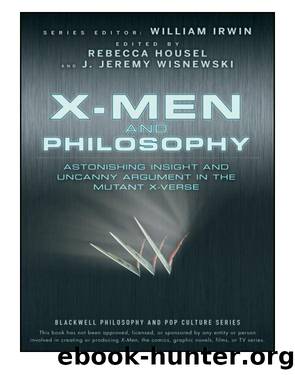
X-Men and Philosophy by William Irwin
Author:William Irwin
Language: eng
Format: epub
Publisher: John Wiley & Sons, Ltd.
Published: 2010-05-10T16:00:00+00:00
X 3 : UNITED
HUMAN ETHICS AND MUTANT MORALITY IN THE X-VERSE
X
MAGNETO, MUTATION, AND MORALITY
Richard Davis
The question is not whether evolution is connected with ethics, but how.
—Michael Ruse, Evolutionary Ethics: A Phoenix Arisen
Charles Darwin’s The Origin of Species (1859) may well be the most influential and controversial book ever written. It contains an idea so revolutionary that it has been compared to Copernicus’s discovery that the Earth revolves around the Sun, and not (as previously thought) the other way around. What is that idea? That individuals everywhere are engaged in a “struggle for existence”—a struggle whose outcome is determined not by God but by Nature herself. Those individuals possessing features that are conducive to survival and reproduction (an opposable thumb, say, or perhaps webbed feet) have an adaptive advantage; they are more likely to beat out their competitors in the game of life. Nature looks on them (or rather on their traits) favorably and passes them down the family tree to the next generation of offspring. And thus organisms change and evolve—in our case, as the first X-Men reminds us, “from a single-celled organism into the dominant species on the planet.”
It is difficult to overemphasize the importance of Darwin’s thought. “If I were to give an award for the single best idea anyone has ever had,” said philosopher Daniel Dennett (b. 1942), “I’d give it to Darwin, ahead of Newton and Einstein and everyone else.”1 Hefty praise indeed. The idea is also deemed “dangerous,” in that it has expansionist tendencies; it tends to creep into other areas, sometimes stepping on the toes of disciplines outside the realm of biology. There are, for example, evolutionary explanations of art, love, mathematics, and even religion.2 If Dennett is right, Darwin’s dangerous idea “unifies the realm of life, meaning, and purpose with the realm of space and time, cause and effect, mechanism and physical law.”3 In other words, it explains the meaning and the purpose of our lives in a purely naturalistic way.
The story of the X-Men is the story of genetic mutation and the incredible powers and advantages it confers. With PhDs in genetics, biophysics, psychology, anthropology, and psychiatry, Charles Xavier, mutant mentor, is no intellectual slouch. One of the world’s most powerful telepaths, he can project his thoughts into the minds of others. With Cerebro—a device that magnifies telepathic ability—at his disposal, it is within his power to annihilate the entire human race. Yet he doesn’t. Indeed, in the face of compulsory mutant registration, Xavier is hopeful. He pleads with his friend Erik Lehnsherr (Magneto), “Don’t give up on them, Erik.” But Magneto merely replies, “I’ve heard these arguments before,” referring, of course, to the forced registration of Jews in Nazi Germany, a seemingly innocuous request that ultimately led to the death camps (where in the first X-Men movie we are introduced to Magneto as a boy).
How can we be sure the nonmutants aren’t proceeding down a similar slippery slope? Professor Xavier assures us, “That was a long time ago. Mankind has evolved since then.
Download
This site does not store any files on its server. We only index and link to content provided by other sites. Please contact the content providers to delete copyright contents if any and email us, we'll remove relevant links or contents immediately.
| Anthropology | Archaeology |
| Philosophy | Politics & Government |
| Social Sciences | Sociology |
| Women's Studies |
The remains of the day by Kazuo Ishiguro(9082)
Tools of Titans by Timothy Ferriss(8490)
Giovanni's Room by James Baldwin(7432)
The Black Swan by Nassim Nicholas Taleb(7193)
Inner Engineering: A Yogi's Guide to Joy by Sadhguru(6835)
The Way of Zen by Alan W. Watts(6669)
The Power of Now: A Guide to Spiritual Enlightenment by Eckhart Tolle(5854)
Asking the Right Questions: A Guide to Critical Thinking by M. Neil Browne & Stuart M. Keeley(5831)
The Six Wives Of Henry VIII (WOMEN IN HISTORY) by Fraser Antonia(5557)
Astrophysics for People in a Hurry by Neil DeGrasse Tyson(5224)
Housekeeping by Marilynne Robinson(4502)
Double Down (Diary of a Wimpy Kid Book 11) by Jeff Kinney(4332)
12 Rules for Life by Jordan B. Peterson(4331)
Ikigai by Héctor García & Francesc Miralles(4310)
The Ethical Slut by Janet W. Hardy(4307)
Skin in the Game by Nassim Nicholas Taleb(4305)
The Art of Happiness by The Dalai Lama(4167)
Skin in the Game: Hidden Asymmetries in Daily Life by Nassim Nicholas Taleb(4050)
Walking by Henry David Thoreau(3998)
